
 Mar 23,2026
本文为 WTiN 授权/转载译文,中文翻译由 [鸿盛数码 HONGSAM] 提供。英文原文附于文末。
原文来源: WTiN (世界纺织信息网)
原文链接: [https://www.wtin.com/article/2026/march/16-03-26/pioneering-green-textile-pigment-inkjet-printing/]
发布日期:2026年3月20日 | 作者:鸿盛数码(Hongsam)
随着全球监管压力的加大以及供应链可持续性披露要求的扩展,像鸿盛数码这样集技术与服务于一体的平台,正成为纺织数码印花行业转型的关键推动力。
全球纺织印花行业正经历由严苛环保法规和数字化加速驱动的根本性变革。本文全面分析了中国领先企业——郑州鸿盛数码科技股份有限公司(股票代码:430616)。该公司通过二十多年的专项研发,在全球纺织涂料喷墨印花市场确立了技术领先地位。研究探讨了鸿盛的核心技术创新,特别是 捷特丝® 纺织涂料墨水系列,并评估了其在不同国际市场中的技术性能、环保效益和商业扩展性。
基于在亚洲、欧洲、北美和非洲的案例及数据,本研究展示了鸿盛通过先进的纳米级水性配方、自主研发的 RCT(快色素)技术工艺 以及广泛的全球技术支持基础设施,如何助力纺织业实现耗水量降低≥70%、能耗降低≥50%以及化学品排放大幅减少,同时保持生产效率和产品质量。研究结果表明,鸿盛的技术生态系统为全球碳中和目标背景下的可持续数码纺织制造提供了可复制的模式。
关键词: 纺织涂料喷墨印花,纺织涂料,数码纺织印花,可持续制造,无水印花,纳米水性墨水,RCT技术,全球技术服务网络,鸿盛数码。
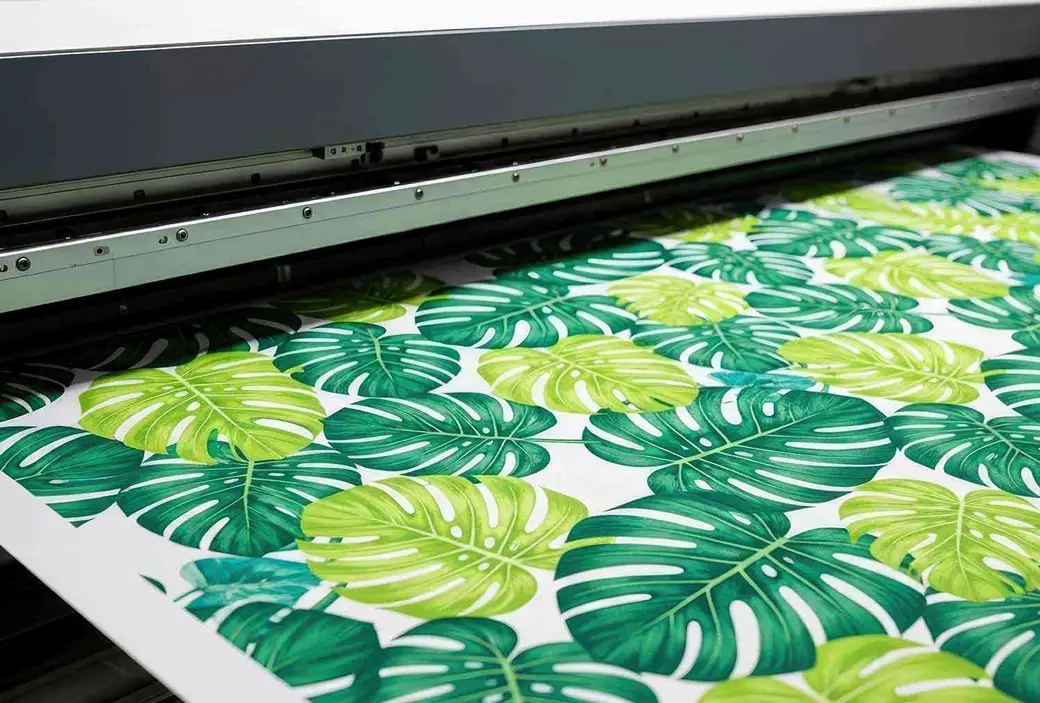
传统纺织印花行业长期以来具有资源密集型和环境影响大的特点,正面临前所未有的脱碳和数字化压力。传统的活性染料印花通常每公斤织物消耗100-150升水,并产生含有重金属、残余染料和助剂的废水。随着欧盟绿色协议、中国“双碳”目标以及企业可持续发展要求的演进,传统印花工艺因高耗能、高污染、高排放等问题面临严峻挑战。
涂料数码印花作为一种技术可行且具备商业规模的替代方案脱颖而出,它省去了高耗水的洗涤和蒸化环节,降低了能耗并增强了生产灵活性。
然而,过去涂料印花在色牢度、手感和工艺可靠性方面的局限性限制了其市场渗透率,特别是在高端纺织领域。
郑州鸿盛数码成立于2001年,自2003年起被认定为国家高新技术企业。公司通过在材料科学、配方化学和工艺工程方面的持续投入,系统性地解决了这些技术障碍。
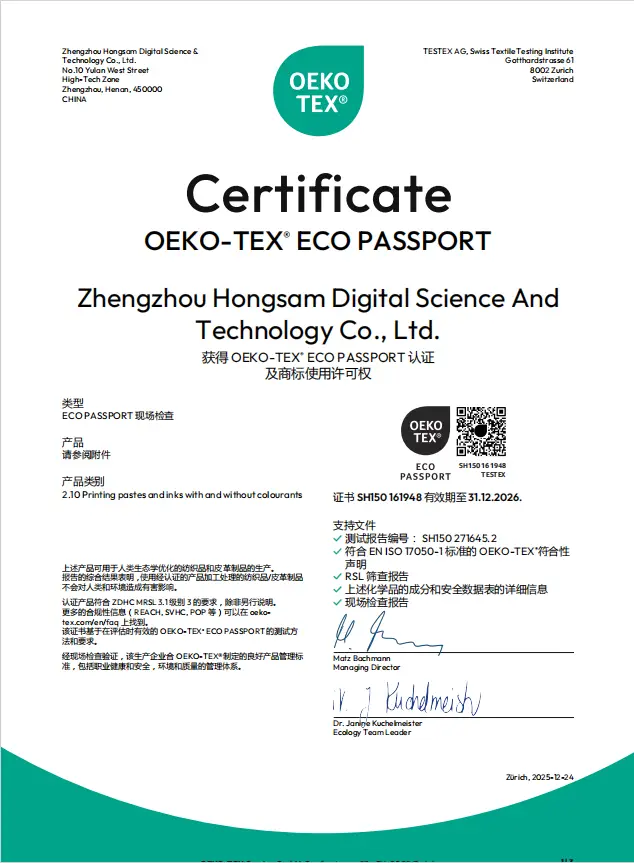
捷特丝® 系列是鸿盛的核心技术成果,采用自主研发的水性纳米工艺,实现纯水性配方,不含有机溶剂,显著降低挥发性有机化合物(VOCs)排放,符合全球最严苛的环保标准。该系列已获得 OEKO-TEX® Eco Passport 认证、REACH 合规认证及 GOTS(全球有机纺织品标准)等各项权威环保认证,满足国际品牌商和监管机构最严格的要求,为全球品牌商和制造商提供安全可靠的绿色解决方案。
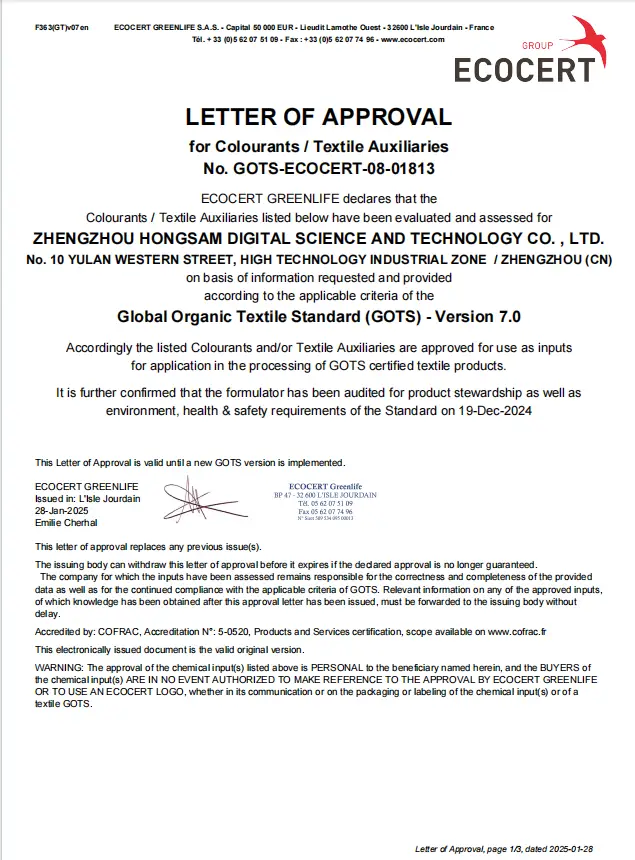
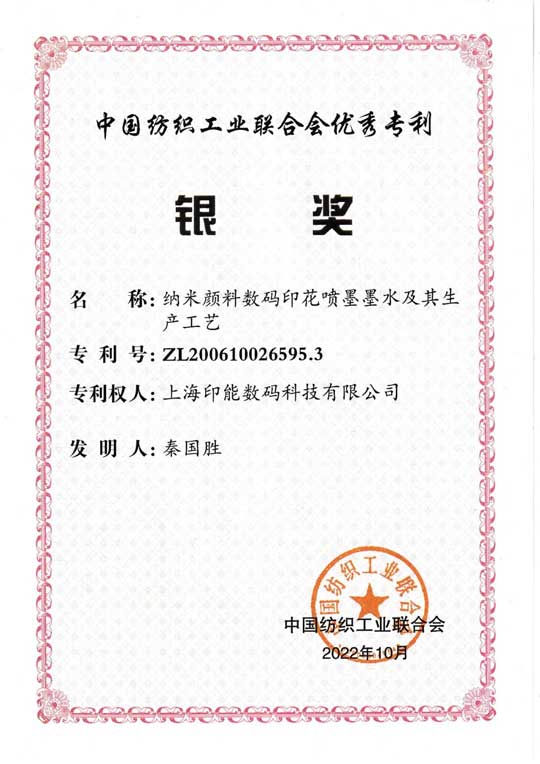
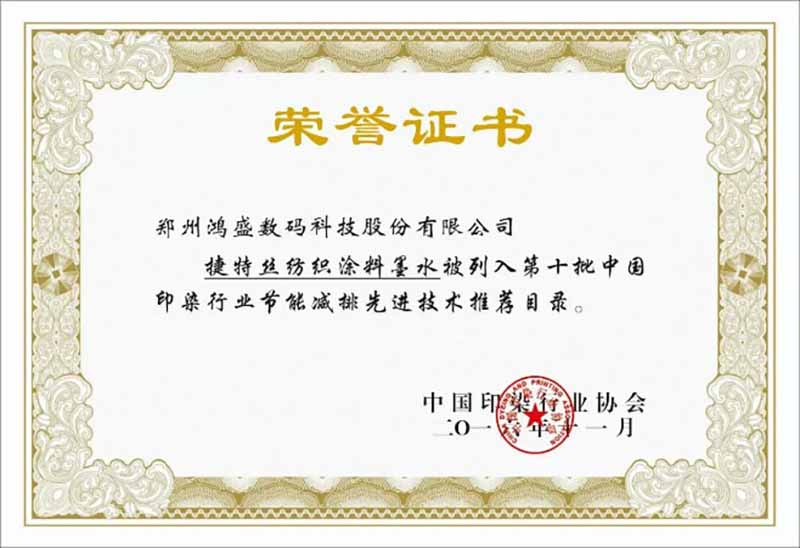
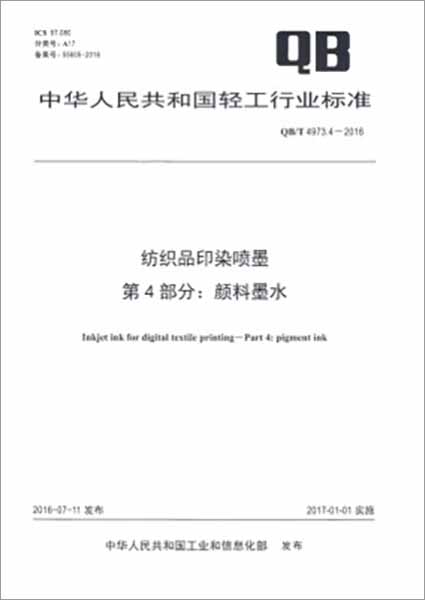
在知识产权保护方面,该技术已获得自2006年至今授予的四项国家发明专利。同时,该技术也获得了行业的高度认可:2022年,“捷特丝”纺织涂料墨水荣获“中国纺织工业联合会优秀专利银奖”,标志着其技术创新性与行业影响力获得权威认可。此外,该产品早于2016年即被列入《中国印染行业节能减排先进技术推荐目录》,持续引领行业绿色技术发展方向。
对 捷特丝® 的技术评估显示,其具备六大竞争优势,共同支撑了工业级规模的应用部署:
鸿盛的“HONGSAM+”经营理念涵盖了从墨水配方到前处理剂、后处理助剂及特定应用工艺的完整生态。
表格1展示了按印花工艺分类的系统化产品架构。
| 打印应用 | 墨水颜色 |
前处理液 (分开单独使用) |
后处理液 (分开单独使用) |
工艺流程 |
| 匹布直喷 |
K C M Y HY R G B OR V VM GY LC LM OP CO W |
PP-01 (1:20-35) PP-03 (1:20-35) PP-17 (1:20-100) |
PA-03 (1:9-19) PA-04 (1:9-19) PA-05 (1:50-100) |
1.(预处理)-印花-固色-(后处理) 2. RCT工艺 3. LATEX工艺 |
| DTG裁片直喷 |
K C M Y VM LC LM R G B OR FM FY OP W |
PP-05 (直接用) PP-08 (浆状可刮式,直接使用) |
预处理-印花-固色 -(后处理) | |
| DTF 烫画 |
K C M Y VM LC LM R G B OR FM FY OP W |
打印-(撒粉-抖粉)-压烫转印-撕膜(提供无粉方案) | ||
| 功能 | 提供各种喷头专用墨水 | 提高色彩饱和度、印花精度 | 改善手感,提高牢度 | 根据应用需求定制 |
表格 1. 鸿盛纺织涂料打印综合产品。
该产品架构展示了对主要工业印花模式的系统性覆盖。
DTF(织物直喷)卷对卷(匹布)印花配置主要针对大批量面料生产。其前处理剂具有分级的浓度范围(标准稀释比例的 PP-01/PP-03,以及稀释比例高达 1:100 的 PP-17),能够针对不同的基材特性和性能要求进行优化。在后处理助剂的选择上(标准应用的 PA-03/PA-04;用于特殊整理的高稀释比 PA-05),则为最终产品的品质属性提供了相应的灵活性。
DTG(成衣直喷)印花采用简化的前处理方案(如即用型溶液 PP-05;可直接涂抹的浆料 PP-08),这反映了裁片或成衣组件与连续卷筒织物在处理特性上的显著差异。
DTF(膜转印)热转印模式完全省去了前处理和后处理阶段,是该产品组合中最精简的工艺架构。其中的可选免上粉方案满足了监管机构和操作人员在颗粒物处理方面日益严格的要求。
2016年起鸿盛数码针对涂料印花行业的快速发展,率先推出前、后处理、印花一体化工艺即RCT工艺(Rapid Colour Technology 快色素工艺),陆续推出各种在线上浆工艺等,“捷傲”水性乳胶墨水印花工艺,进一步简化工艺流程,大大提高生产效率,节约生产成本。为更多介质印花及环保生产提供更多的路径和方案,为行业发展提供更多适用场景及强大动能。
捷傲® 水性乳胶墨水入选了中国印染行业协会发布的《第十六批节能减排先进技术推荐目录(2023年度)》。捷傲® 水性乳胶墨水实现了在非吸收性和疏水性基材(包括人造革、功能性纺织品及涂层材料)上的水性喷墨印花,而这些基材此前通常需要使用溶剂型或 UV 固化墨水。这一能力的扩展,填补了高性能及技术类纺织应用在可持续数码印花领域的重要市场空白。
3.1 亚太地区:规模化制造与环保合规
在中国主要的纺织制造区域(华东、华南、华中),鸿盛数码的技术已集成到高速数码生产线中,逐步取代传统的平网和圆网印花系统。在单个工厂规模上,年度废水减排量超过100万吨,助力企业实现环评升级和合规生产。
来自山东某企业的运营稳定性数据显示(该企业配备 MS-JPK 32 京瓷喷头,自2017年起运行),自2019年采用 捷特丝® 墨水以来实现了持续生产,单个喷头的使用寿命超过三年。广州的一家工厂在早期使用其他供应商产品遇到技术困难后,于2019年引入 捷特丝® 并实现盈利,随后规模从数台设备扩大至10多套生产系统。此外,华东某领先家纺企业作为战略供应商,目前运行着数十套基于 捷特丝® 的印花系统。
在越南,胡志明市的一家知名服装制造集团在实施该方案后,生产周期从7天缩短至24小时以内,在满足欧美品牌可持续发展要求的同时,降低了库存持有成本和资源浪费。在获得相关认证后,其订单量增长了35%。
3.2 欧洲:高端市场渗透
意大利普拉托的高端家纺制造商已采用 捷特丝® 涂料方案,针对设计师市场进行小批量、定制化生产。这些产品凭借其极低的环境影响和卓越的色彩还原度,多次获得国际设计奖项,并入选米兰家具展绿色推荐名单。
3.3 北美:分布式制造与供应链优化
加利福尼亚州的一家运动服装品牌采用了鸿盛的数码印花集成解决方案,实现了本土化的按需生产。通过消除跨太平洋物流,该品牌减少了年度运输相关碳排放,并实现了约18%的物流成本降幅,同时增强了对快时尚趋势周期的响应能力。
3.4 非洲:技术转移与可持续工业发展
通过与埃及领先企业的合作,鸿盛建立了适应当地水质和电力基础设施条件的现代化数码印花能力,避免了历史上“先污染、后治理”的传统工业化老路。
鸿盛数码的研发体系涵盖了19项授权发明专利、72项国内外注册商标,并积极参与了9项国家及行业标准的制定。主要贡献包括:
企业发展里程碑包括:2023年挂牌新三板(NEEQ)创新层、2023年获评河南省“专精特新”企业、2023年获得中纺联“专精特新”企业称号,以及2025年荣获“中国油墨行业可持续发展企业”奖。
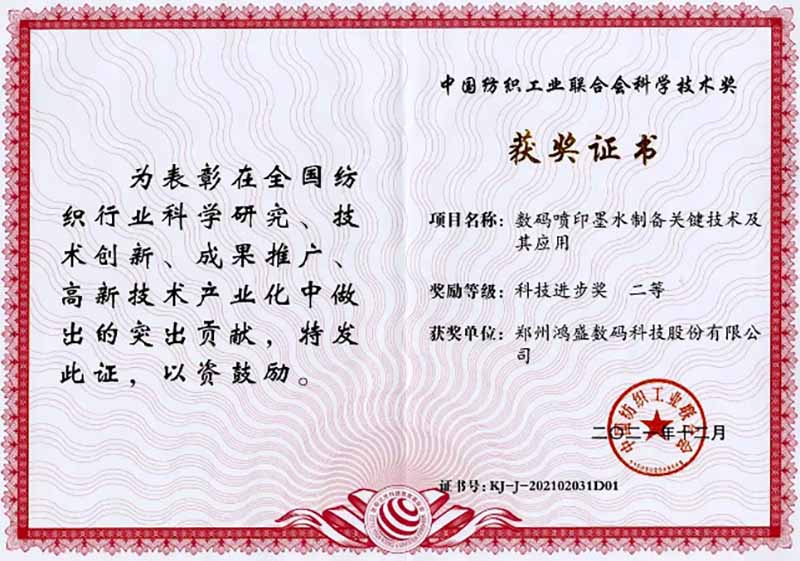
鸿盛数码的“HONGSAM+”经营理念通过以下布局整合了技术、产品与服务能力:
国内网络: 4家子公司、9个区域办事处、4个国际贸易部门。
国际分销: 覆盖全球主要纺织制造区域的授权经销商网络。
技术服务: 提供售前咨询、方案实施支持及售后维护。
这一基础设施确保了在复杂的生产环境下能够提供快速响应的技术支持,降低了客户的实施风险,并加速了国际客户的投资回报。
鸿盛数码在喷墨墨水领域深耕二十载,打造了一个高度整合的喷墨技术平台,同时满足了纺织行业对环保性能、经济可行性和生产质量的多重需求。以 捷特丝® 纺织涂料墨水系统为核心,在 RCT(快色素)工艺创新、捷傲® 水性乳胶墨水以及全球技术服务体系的共同支撑下,充分证明了可持续的数码纺织制造能够在全球不同地域和市场背景下实现工业化规模应用。
表1所列出的全面产品组合,展示了针对特定应用场景开发解决方案的系统化方法,这正是鸿盛数码独特的市场定位。量化的性能提升——耗水减少≥70%、能耗降低≥50%、生产周期缩短≥70%——有力验证了涂料数码印花作为主流生产模式的技术和商业可行性。随着全球监管压力的日益严苛以及供应链可持续性披露要求的扩展,像鸿盛这样集“技术+服务”于一体的整合平台,将成为驱动行业转型的关键力量。
未来的发展趋势将涵盖更广阔的应用领域(包括服装、家纺、户外用品、汽车内饰、文创产业及工业应用)、更深层次的国际合作,以及持续推动“数码+绿色”制造的深度融合,而这也正是下一代纺织生产的核心定义。
了解更多信息,请访问:
Original English Article by WTiN:
Sponsored by Hongsam
As global regulatory pressure intensifies and supply chain sustainability disclosure requirements expand, integrated technology-service platforms such as Hongsam's represent critical enablers of industry transformation within the digital textile printing segment.
The global textile printing industry is undergoing a fundamental transformation driven by stringent environmental regulations and accelerating digitalisation. This paper presents a comprehensive analysis of Zhengzhou Hongsam Digital Science and Technology Co, Ltd. (stock code: 430616), a leading Chinese enterprise that has established technological leadership in the global textile pigment inkjet printing market through two decades of specialised research and development. The study examines Hongsam's core technological innovations, particularly the Jettextile® textile pigment ink series, and evaluates their technical performance, environmental benefits and commercial scalability across diverse international markets. Drawing upon operational data from enterprise deployments in Asia, Europe, North America and Africa, this research demonstrates how Hongsam's integrated approach – combining advanced nanoscale aqueous formulations, proprietary Rapid Colour Technology (RCT) processes and extensive global technical support infrastructure – enables the textile industry to achieve substantial reductions in water consumption (≥70%), energy usage (≥50%), and chemical discharge while maintaining production efficiency and product quality. The findings indicate that Hongsam's technological ecosystem represents a replicable model for sustainable digital textile manufacturing in the context of global carbon neutrality objectives.
Keywords: Textile pigment inkjet printing; textile pigment ink; digital textile printing; sustainable manufacturing; waterless printing; nanoscale aqueous ink; rapid colour technology; global technical service network; HONGSAM.
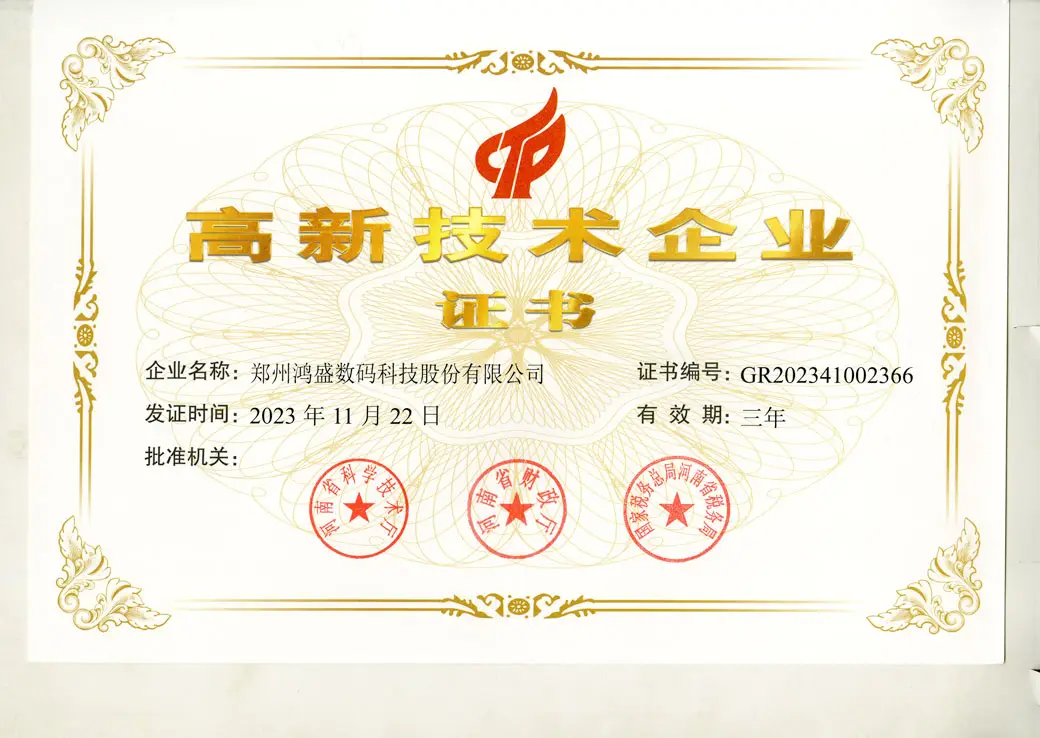
The textile printing industry, historically characterised by resource-intensive wet processing and substantial environmental influence, faces unprecedented pressure to decarbonise and digitise. Conventional reactive dye printing typically consumes 100–150 litres of water per kilogram of printed fabric and generates effluent containing heavy metals, residual dyes and auxiliary chemicals [1]. Regulatory frameworks including the EU Green Deal, China's ‘dual carbon’ targets and evolving corporate sustainability mandates have rendered traditional production modalities economically untenable for an increasing proportion of market participants [2]. Pigment-based digital inkjet printing has emerged as a technically viable and commercially scalable alternative, offering elimination of water-intensive washing and steaming stages, reduced energy consumption and enhanced production flexibility [3]. Hongsam’s High-tech Enterprise Certificate Hongsam’s High-tech Enterprise Certificate.
However, historical limitations in colour fastness, hand feel and process reliability have constrained market penetration, particularly in premium textile segments.
Zhengzhou Hongsam Digital Science and Technology Co, Ltd – founded in 2001 and designated a National High-tech Enterprise since 2003 – has systematically addressed these technical barriers through sustained investment in materials science, formulation chemistry and process engineering. This paper analyses Hongsam's technological architecture, commercial deployment patterns and service infrastructure to elucidate the mechanisms underlying its competitive positioning in international markets.
The Jettextile® textile pigment ink series represents Hongsam's principal technological achievement, developed through proprietary nanoscale aqueous processing techniques. The formulation achieves complete aqueous carrier systems without organic solvent content, thereby minimising volatile organic compound (VOC) emissions throughout the product lifecycle. Independent certification includes the OEKO-TEX Eco Passport, REACH compliance and Global Organic Textile Standard (GOTS) accreditation, satisfying the most stringent requirements of international brand owners and regulatory authorities.
Intellectual property protection encompasses four national invention patents awarded between 2006 and present, with the technology recognised by the China National Textile and Apparel Council (CNTAC) through the 2022 Excellent Patent Silver Award and inclusion in the China Dyeing and Printing Association Energy-Saving and Emission-Reduction Advanced Technology Recommendation Catalogue (2016).
Technical evaluation of the Jettextile® platform reveals six interconnected competitive advantages that collectively enable industrial-scale deployment:
Substrate versatility. The pigment-based chemistry exhibits compatibility with cellulosic fibres (cotton, linen), protein fibres (silk, wool), synthetic fibres (polyester, polyamide), and blended constructions across woven, knitted and nonwoven architectures. This universality reduces technical complexity for multi-product manufacturing environments and supports mass-customisation business models.
Process streamlining. Production cycle compression represents a critical operational benefit. Conventional reactive printing requires 7–9 discrete stages: pretreatment (sizing), printing, drying, steaming, washing, soaping and final drying. The Jettextile®-enabled process reduces this to three core operations: optional pretreatment, printing and fixation, achieving cycle time reductions exceeding 70% and enabling linear production flow compatible with digital manufacturing execution systems.
Resource efficiency. Quantified environmental performance demonstrates water consumption reduction of ≥95%, energy reduction of ≥50%, and chemical usage reduction of ≥60% relative to conventional reactive processes. The elimination of aqueous effluent generation removes the capital and operating burden of wastewater treatment infrastructure, particularly significant for facilities in water-stressed regions or jurisdictions with stringent discharge regulations.
Economic optimisation. Cost structure advantages manifest across multiple dimensions: reduced capital investment requirements for entry-level system configurations; diminished utility consumption (water, electricity, steam); simplified quality control protocols due to reduced process variability; and elimination of environmental compliance expenditures associated with effluent management. Digital production planning systems further amplify these advantages through precise cost attribution and continuous optimisation.
Reproducibility and quality consistency. The direct digital workflow eliminates variability sources inherent in analogue processes (screen engraving, paste preparation, colour matching). Reduced sensitivity to environmental conditions (temperature, humidity, water quality) ensures batch-to-batch and sample-to-production colour consistency essential for data-driven quality management and digital twin implementation. First-grade yield improvements directly enhance economic returns.
Durability performance. Advanced binder chemistry and optimised pigment dispersion achieve light fastness ratings of 6–7 (ISO 105-B02) and excellent chlorine bleach resistance, satisfying requirements for outdoor textiles, home furnishings and technical applications previously considered exclusive to reactive dye systems.
Hongsam's ‘HONGSAM+’ operational philosophy encompasses a comprehensive product ecosystem extending beyond core ink formulations to encompass pretreatment agents, post-treatment chemistries and application-specific process protocols. Table 1 presents the systematic product architecture organised by printing methodology.
| Printing application | Ink | Pretreatment agent (sorts) | Posttreatment agent (sorts) | Process |
|
Roll-to-roll (piece goods fabric) |
K C M Y HY R G B OR V VM GY LC LM OP CO W |
PP-01, (1:20-35) PP-03 (1:20-35) PP-17 (1:20-100) |
PA-03 (1:9-19) PA-04 (1:9-19) PA-05 (1:50-100) |
1. (Pretreating), printing, fixation, (posttreating) 2.RCT 3.LATAX |
| DTG |
K C M Y VM LC LM R G B OR FM FY OP W |
PP-05 (Direct use) PP-08 (Paste use) |
Pretreating, printing, fixation, (posttreating) | |
| DTF |
K C M Y VM LC LM R G B OR FM FY OP W |
Printing to film, (powder coating), heat transfer printing | ||
| Functional applications | Enhanced colour saturation and printing precision | Improved handfeel or fastness properties | Customised per application requirements |
Table 1. Hongsam’s integrated product portfolio for textile pigment inkjet printing.
Note: K = Black, C = Cyan, M = Magenta, Y = Yellow, HY = High-Yield Yellow, R = Red, G = Green, B = Blue, OR = Orange, V = Violet, VM = Vivid Magenta, GY = Gray, LC = Light Cyan, LM = Light Magenta, OP = Opaque, CO = Coating, W = White, FM = Fluorescent Magenta, FY = Fluorescent Yellow. Dilution ratios indicate pretreatment agent-to-water proportions.
The product architecture demonstrates systematic coverage of principal industrial printing modalities.
DTF (direct-to-fabric) roll-to-roll (piece goods fabric) printing configurations address high-volume fabric production, with graduated pretreatment concentration ranges (PP-01/PP-03 at standard dilution versus PP-17 at extended dilution up to 1:100) enabling optimisation for diverse substrate characteristics and performance requirements. Post-treatment agent selection (PA-03/PA-04 for standard applications; PA-05 at elevated dilution for specialised finishes) provides corresponding flexibility in final product attributes.
DTG (direct-to-garment) printing employs simplified pretreatment protocols (PP-05 as ready-to-use solution; PP-08 as directly applicable paste) reflecting the distinct handling characteristics of pre-cut garment components versus continuous fabric rolls.
DTF (direct-to-film) heat transfer modality eliminates pretreatment and post-treatment stages entirely, representing the most streamlined process architecture within the portfolio. The optional powder-free formulation addresses evolving regulatory and operational preferences regarding particulate handling.
Since 2016, Hongsam has progressively developed integrated processing solutions that unify ink, pretreatment, and post-treatment chemistries within coherent technical systems. The Rapid Colour Technology (RCT) protocol, subsequently extended to include in-line sizing processes and the JETALL® water-based latex ink platform, exemplifies this systems-level approach.
The JETALL® system, recognised in the 16th China Dyeing and Printing Association Energy-Saving and Emission-Reduction Advanced Technology Recommendation Catalogue (2023), enables aqueous inkjet printing on non-absorbent and hydrophobic substrates—including synthetic leather, technical textiles and coated materials – previously requiring solvent-based or UV-curable systems. This capability expansion addresses a significant market gap in sustainable digital printing for high-performance and technical textile applications.
3.1 Asia-Pacific: Scale manufacturing and environmental compliance
In China's principal textile manufacturing regions (East China, South China, Central China), Hongsam's technology has been integrated into high-speed digital production lines replacing conventional flat-screen and rotary-screen systems. Annual wastewater reduction exceeds one million tons at individual facility scale, enabling environmental assessment upgrading and regulatory compliance.
Operational stability data from a Shandong-based enterprise (MS-JPK 32 Kyocera printheads, operational since 2017) demonstrate continuous production following Jettextile® adoption in 2019, with individual printhead service life exceeding three years. A Guangzhou facility, following initial technical difficulties with alternative suppliers, achieved operational profitability upon Jettextile® implementation in 2019, expanding from multiple units to 10+ production systems. A leading East China home textile enterprise operates several dozen Jettextile®-enabled systems as a strategic supplier.
In Vietnam, a prominent Ho Chi Minh City-based garment manufacturing group achieved production cycle compression from 7 days to <24 hours post-implementation, reducing inventory carrying costs and resource waste while satisfying European and North American brand sustainability requirements. Order volume increased 35% following certification attainment.
3.2 Europe: Premium market penetration
Prato, Italy-based high-end home textile manufacturers have adopted Jettextile® systems for small-batch, customised production targeting designer markets. Products distinguished by minimised environmental impact and superior colour reproduction have received multiple international design awards and inclusion in Milan Furniture Fair green recommendation listings.
3.3 North America: Distributed manufacturing and supply chain optimisation
A California-based athletic apparel brand implemented Hongsam's integrated digital printing solution to enable localised, on-demand production. Elimination of trans-Pacific logistics reduced annual transportation-related carbon emissions and achieved approximately 18% logistics cost reduction, concurrently enhancing responsiveness to fast-fashion trend cycles.
3.4 Africa: Technology transfer and sustainable industrial development
Collaboration with leading Egyptian enterprises has established modern digital printing capability adapted to local water quality and electrical infrastructure conditions, avoiding the ‘pollute first, treat later’ development trajectory characteristic of historical industrialisation patterns.
Hongsam's research and development infrastructure encompasses 19 authorised invention patents, 72 registered trademarks (domestic and international), and active participation in 9 national and industry standard formulation initiatives. Principal contributions include:
Corporate development milestones include a 2023 listing on the National Equities Exchange and Quotations (NEEQ) Innovation Layer, 2023 recognition as Henan Province Specialized and Sophisticated Enterprise, 2023 CNTAC Specialised and Sophisticated Enterprise designation, and a 2025 China Ink Industry Sustainable Development Enterprise award.
Hongsam's ‘HONGSAM+’ operational philosophy integrates technology, product and service competencies through:
This infrastructure ensures responsive technical support for complex production environments, mitigating implementation risk and accelerating return on investment for international customers.
Hongsam's two-decade specialisation in inkjet ink development has produced a technologically integrated platform that addresses the textile industry's simultaneous requirements for environmental performance, economic viability and production quality. The Jettextile® textile pigment ink system, supported by RCT process innovation, the JETALL® latex ink platform, and global technical service infrastructure demonstrates that sustainable digital textile manufacturing can achieve industrial scale across diverse geographic and market contexts.
The comprehensive product portfolio presented in Table 1 illustrates the systematic approach to application-specific solution development that distinguishes Hongsam's market positioning. Quantified performance improvements – water reduction ≥70%, energy reduction ≥50% and cycle time compression ≥70% – validate the technical and commercial feasibility of pigment-based digital printing as a mainstream production modality. As global regulatory pressure intensifies and supply chain sustainability disclosure requirements expand, integrated technology-service platforms such as Hongsam's represent critical enablers of industry transformation.
Future development trajectories encompass expanded application domains (apparel, home textiles, outdoor products, automotive interiors, cultural creative industries, industrial applications), deepened international collaboration, and continued advancement of the digital-green manufacturing convergence that defines next-generation textile production.
For more information, visit www.ink4you.com or www.hongsam.cn.
[1] European Commission. (2020). EU Strategy for Sustainable and Circular Textiles. Brussels: EU Publications.
[2] Shen, L., et al. (2020). Carbon Footprint of Textile Recycling: A Case Study of open-loop Recycling of Wool. Journal of Cleaner Production, 259, 120773.
[3] Provost, J. (2019). Digital Textile Printing: A Disruptive Technology Enabling the Circular Economy. Textile Progress, 51(3), 143-203.
[4] China National Textile and Apparel Council. (2022). Annual Report on Technological Innovation in China's Textile Industry. Beijing: CNTAC.
[5] OEKO-TEX® Association. (2023). ECO-PASSPORT by OEKO-TEX®: Standard Documentation. Zürich: OEKO-TEX®.